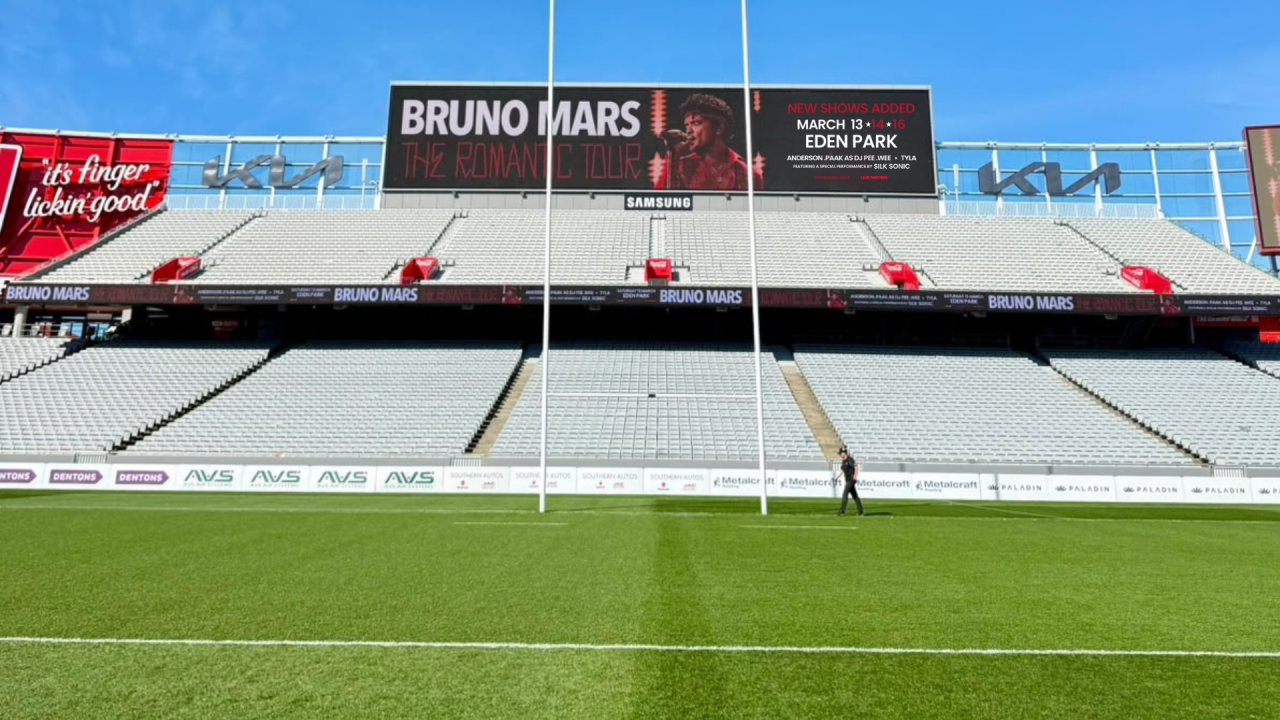






Last week was historic for Eden Park, but perhaps not for the most obvious reason.
Within 45 minutes of the Bruno Mars presale beginning, demand was strong enough to add a second concert on Sunday 14 March 2027. A third followed, resulting in three sold-out concerts and giving tens of thousands more people the chance to experience one of the world’s leading artists in New Zealand.
While the extraordinary demand made the headlines, what was just as interesting was our ability to respond to it.
Until recently, Eden Park could not have held that Sunday concert. Under our previous planning rules, concerts on Sundays were prohibited unless the following day was a public holiday.
Under the old rules, if the market asked within 45 minutes whether Eden Park could make another night available, our answer would have been no.
This matters for more than one concert event as it can influence whether a city hosts an artist, or not.
Global tours operate across cities and countries on tightly constructed schedules. Promoters need the ability to hold multiple dates, respond quickly when demand exceeds expectations and make decisions with confidence. The flexibility available at a venue has an impact on whether a city is a commercially viable option.
This is an element that can easily be lost when we talk about planning regulations.
While we naturally think about stadium capacity, airports, hotels, public transport and event funding as the infrastructure required to compete for major events, the regulatory environment in which venues operate matters too. A world-class stadium has limited value if it cannot be used with the flexibility the global events market requires.
This is why the investigation initiated by the Minister Responsible for Resource Management Act Reform, Hon Chris Bishop, and the subsequent changes to Eden Park’s planning settings were so significant.
At the time, much of the discussion understandably focused on operating hours, event numbers and days of the week. The Bruno Mars ticket sales provided a practical demonstration of what those settings actually mean – and why this flexibility matters if New Zealand wants to compete for the world’s biggest events.
If we genuinely want to secure the world’s biggest sporting and entertainment events, then I believe three things need to align: permission, investment and capability.
Permission means having regulatory settings that allow venues and cities to respond when opportunities arise.
Investment means having the ability to compete for highly sought-after events against other cities and countries that recognise their economic and strategic value.
Capability means having the venues, transport, accommodation, workforce and operational expertise to deliver those events successfully, repeatedly and at scale.
The Government’s announcement today that they are establishing a new long-term funding pathway to help councils attract and retain major events is another important part of the equation.
Major events are intensely competitive. Cities and countries can be competing for them years before the public ever hears about them. Promoters and rights holders consider funding, venue capacity, infrastructure, scheduling flexibility, operational capability and, importantly, confidence that a destination can deliver.
Funding helps us compete for the opportunity. Enabling planning settings allow us to respond to it. Infrastructure and capability allow us to deliver it.
We need all three.
The long-term nature of that funding is also important.
A credible major-event strategy cannot be built one government budget cycle at a time. Events are secured years in advance, and long-term certainty allows cities to build pipelines, make strategic choices about the events they pursue and compete for opportunities that may not arrive until several years into the future.
It also recognises something that is sometimes overlooked when public investment in major events is discussed: the right event is not simply entertainment expenditure – it is an investment in tourism, economic activity and New Zealand’s international profile.
Last week, three sold-out Bruno Mars concerts provided a visible example, but there is another side to this that is much harder to quantify.
New Zealanders also know what happens when major tours bypass us. Fans jump on a plane to Australia to see an artist perform there, taking their hard-earned New Zealand dollars and spending them in Australian hotels, restaurants, cafes and bars.
What is harder to see are the events that never make it far enough for us to know we missed them. There’s no announcement when an international tour decides a market does not work. There is no sold-out sign for the concert that was never scheduled, no visitor spending to measure and no economic impact report for the event that went somewhere else.
Last week showed what can happen when audience demand, government policy, event investment and venue capability align. Three sold-out concerts are an extraordinary outcome, but they are also a practical demonstration that decisions made well before an event is announced can determine whether that event comes to New Zealand, whether we can respond when demand exceeds expectations and ultimately how much value that opportunity creates for the country.
For New Zealand, the challenge is to create a sustainable environment in which promoters, sporting bodies and rights holders know we are capable of saying yes because the world’s biggest events will not wait for us to become ready – we must already be ready when the opportunity arrives.