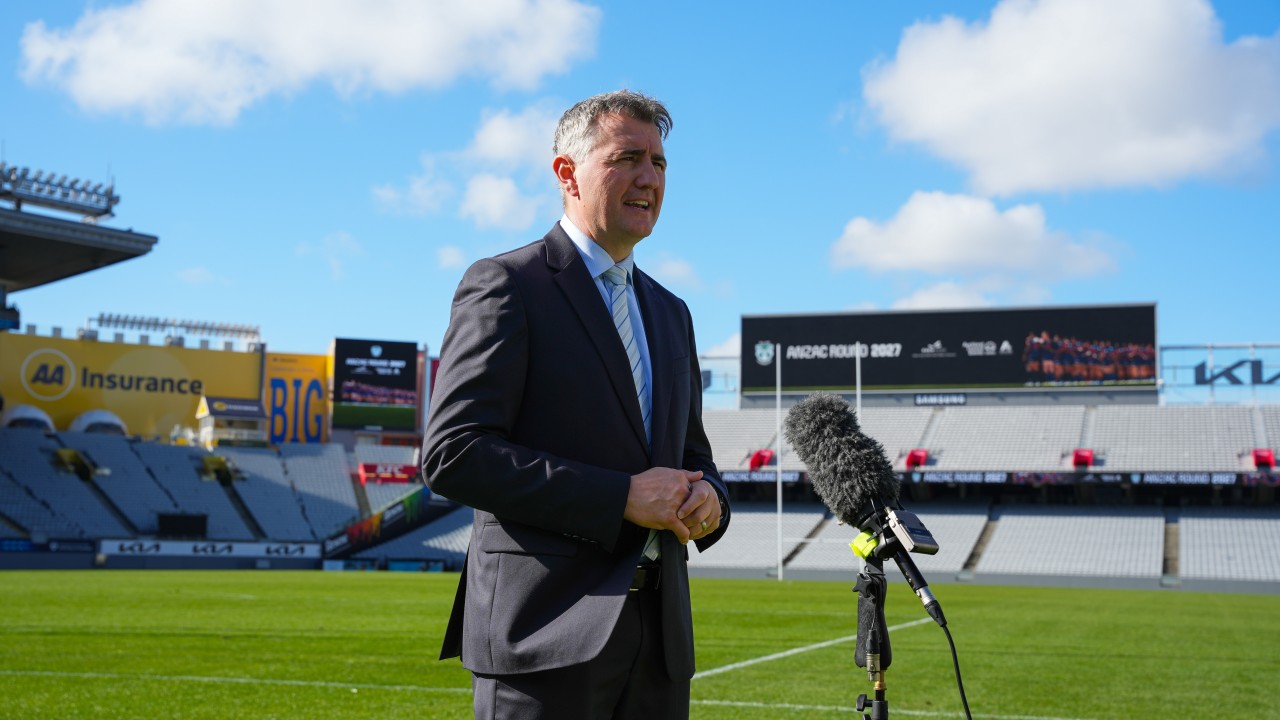






Leading New Zealand’s national stadium has always felt like more than leading a venue. Eden Park is a stadium, but it is also a place of connection where people come together to experience sports matches, concerts, cultural and community events, functions and conferences, and leave with moments that stay with them long after they’ve gone.
Over the past 10 years, a lot of people have asked what has shaped my approach to leadership. The answer is simple – it’s a combination of principles that have stayed consistent even as the stadium, the industry and the expectations of what Eden Park should be delivering have changed.
The first of those principles is that relationships matter.
Stadiums are relationship businesses. Major events are not secured because we have built the venue or made a phone call. Community trust is not built through one meeting. Partnership programmes are not strengthened simply by offering signage opportunities. The work happens over years, through consistent engagement, mutual respect and a willingness to understand what matters to the people around you.
At Eden Park, that includes our staff, contractors, Trustees, partners, hirers, promoters, sporting organisations, government, council, local boards, residents’ associations, neighbours, suppliers, schools, community organisations and the thousands of people who come through our gates every year. Each relationship matters because each contributes to Eden Park’s role as New Zealand’s national stadium.
It is easy to think of a stadium as a physical asset, but in reality, it is a network of people. Every event depends on trust between teams. Every partnership depends on shared values and a belief in what can be achieved together. Every conversation with a stakeholder, whether supportive or challenging, is part of the wider responsibility that comes with leading a venue that means so much to so many people. We know not everyone will always agree, but when relationships are built on trust, honesty and consistency, it becomes possible to keep moving forward.
The second principle is to keep on learning.
When I started in the venue industry, stadium management as a defined profession was still a developing concept. Today, running a stadium involves far more than opening the gates on event day. It is more like operating a small city.
Next week, when we host the All Blacks as they take on Ireland, we will welcome roughly the same number of people through our gates as live in Nelson. That comparison puts the responsibility into perspective. A modern stadium requires knowledge of infrastructure, asset management, event economics, technology, sustainability, risk, customer experience, government settings, global touring models, commercial partnerships, community expectations and the changing ways people choose to spend their time and money.
It also requires the ability to bring all of that together in real time. Safety, transport, security, technology, hospitality, broadcast requirements, turf, lighting, communications and the expectations of tens of thousands of people all need to be managed at once.
This level of complexity is why I value education and professional development. My own education has been an important part of my career, but learning is not confined to a classroom or a qualification. It is a mindset. Some of the most valuable learning comes from visiting other venues, listening to people in other industries, understanding what global cities are doing well and being honest about where we need to improve. It also comes from people inside your own organisation. I am constantly learning from our turf team, operations team, commercial team, facilities team and the many people who understand parts of this business in far greater detail than I ever could.
The third principle is to love the work.
That does not mean every day is easy, and I am not suggesting that loving the work is the same as loving every task. It is about believing the work matters.
For me, it is knowing that when Eden Park is at its best, it creates something people carry with them, whether that is a child’s first time sitting on the turf, a family attending their first concert together, a fan watching their team create history, a global artist performing on New Zealand’s biggest stage, a community group using the stadium in a way they never expected, a player scoring their first try or hitting a six into the stands, or a city feeling busier and more vibrant because a major event has brought people together.
I often say events provide escapism. In a world where people are busy, distracted and often under pressure, live experiences give people a reason to come together and share something. They create memories, connections, and pride. Loving the work means respecting that responsibility. It means understanding that while the event may be entertainment for the fans, for those delivering it, it is a commitment to excellence, safety and care. It means being willing to do the difficult, unseen work because the outcome matters to people.
The fourth principle is remembering who helps you carry it.
People often say being CEO is the loneliest job in an organisation, but the reality is that no leadership role is ever carried alone. Certainly not one that operates 24 hours a day, seven days a week, with the expectations that come with Eden Park. The visible part of leadership is often individual, but the reality is always collective.
At work, that starts with the team. I am incredibly proud of the people at Eden Park because they care deeply about this place. They adapt, they innovate, they solve problems and they consistently deliver under pressure. Much of their work is unseen by the public, but without it, there is no event, no experience and no memory created.
Beyond work, whānau matters just as much. Leadership roles require support, patience and perspective from the people closest to you, and my family has always been central to why I do what I do. My children have grown up with Eden Park as their second home and, together with my wife, they have seen the long hours, the event days and the moments that make this place so special.
They have also reminded me why the work matters. A stadium like Eden Park is not only about the people who walk through the gates today, but about the memories we create for the next generation.
That perspective is important because a stadium can consume your attention if you let it. There is always another event, another issue, another opportunity, another challenge. Having people around you who provide support and perspective helps you lead with more balance, more humility and more clarity.
For me, these principles are not separate from the way Eden Park operates; they are connected to it.
- Relationships matter because a national stadium cannot operate in isolation.
- Learning matters because a stadium with 125 years of history must continue to evolve.
- Loving the work matters because live experiences demand care, energy and belief.
- Whānau matters because leadership is strongest when it is grounded in something bigger than the role itself.
Eden Park has changed significantly over recent years. We have diversified our content, increased utilisation, strengthened partnerships, invested in the asset and challenged long-held assumptions about what a stadium can be. But beneath those changes, the principles have remained consistent.
Lead through relationships. Keep learning. Love the work. Remember who helps you carry it. They are simple ideas, but they matter because leading Eden Park is not only about managing a stadium; it is about stewarding a place that belongs to Auckland and New Zealand, creating moments that bring people together, and ensuring this national stadium continues to serve future generations.
It is also a privilege to lead.