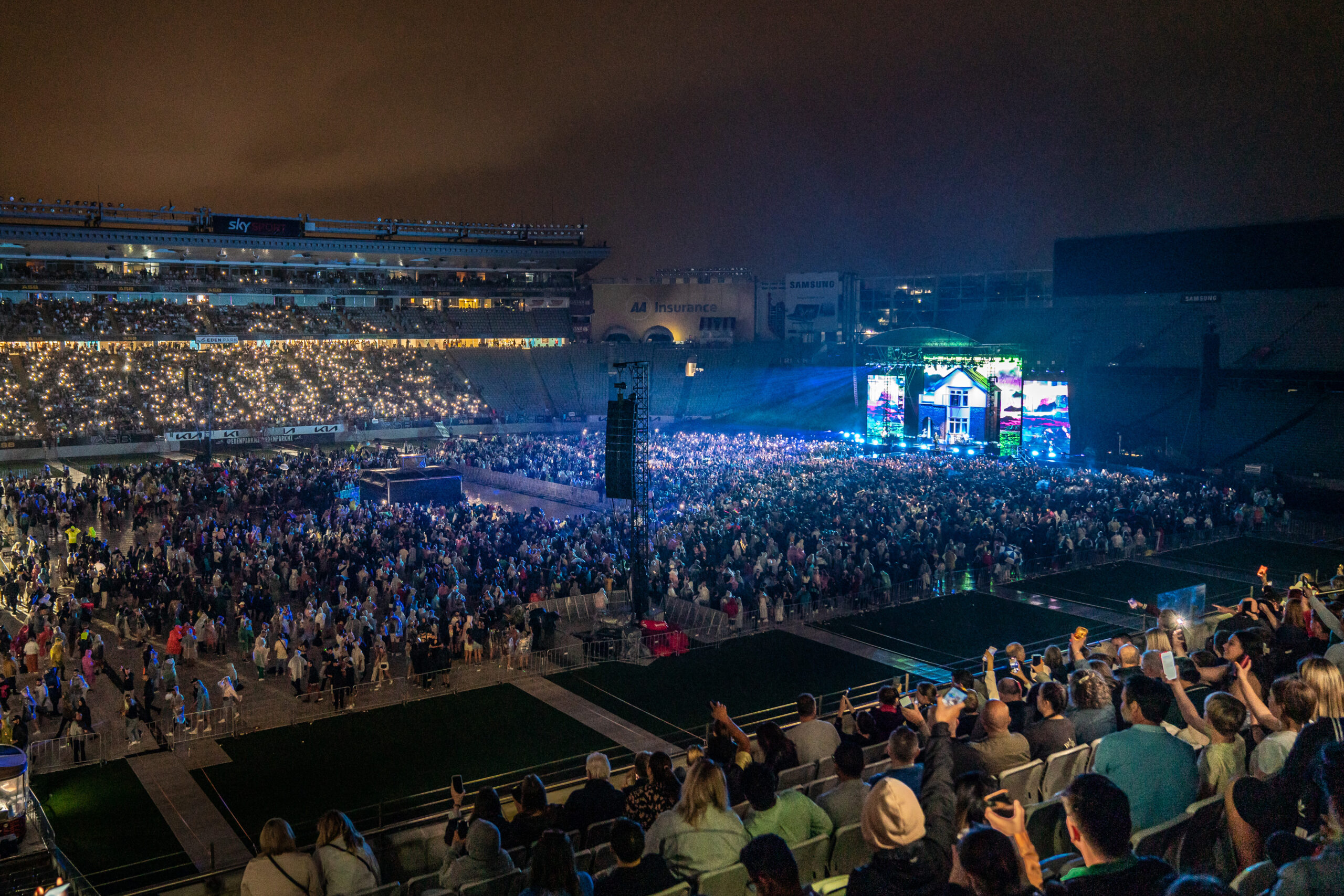






When people hear “built for the world stage”, they probably picture exactly what the image shows – a full stadium, a huge production, lights, screens, an international sports match or one of the world’s biggest artists performing in front of tens of thousands of people.
But that is really only the final product.
What makes a venue capable of hosting the world’s biggest events is everything that sits behind that moment: the scale, infrastructure, people, transport connections, operational capability and experience required to bring tens of thousands of people, and an increasingly complex global event, together at exactly the same time.
A venue is not “built for the world-stage” simply because it might host a big event. It becomes world-class because it has been developed, operated and continually evolved to enable those events to succeed – time and time again. In other words, hosting a major event once or twice is not the same as being built to host major events repeatedly.
Scale is part of this.
Eden Park is the only venue in New Zealand capable of hosting 50,000 people for sport and scaling to 65,000 for concerts. For the biggest international sports games and entertainment tours, this capacity matters. It impacts how many people can experience an event, whether the commercial model works and ultimately whether New Zealand can accommodate the level of demand associated with truly global content.
But capacity alone does not make a venue world-class.
The bigger the event, the more important the parts of the stadium that most people never see become.
When an international sporting body, rights holder or promoter selects a venue, they are considering changing rooms, warm-up and medical facilities, broadcast positions, media operations, accreditation, security, hospitality, production access, power, connectivity, loading areas, artist and crew facilities, playing surfaces and dozens of other requirements.
Behind every major event is another event happening out of sight.
There are athletes, performers, officials, broadcasters, production crews, commercial partners, security teams, caterers and thousands of people who need to be able to do their jobs effectively. A world-class venue needs to work for all of them as well as it works for the ticketholder sitting in the stands.
Temporary infrastructure and event overlay can play an important role in creating great events, but there is a difference between temporarily configuring a space to accommodate a major event and having permanent infrastructure, systems and operational capability designed to deliver them repeatedly.
The more that needs to be created for each event, the more complexity, cost, lead time and risk are introduced. The real test of being “built for the world-stage” is therefore not simply whether a venue can make an event work once, it is whether it can deliver at that level safely, efficiently and consistently, while retaining the flexibility to adapt when an event requires something different.
This is also where people matter.
Infrastructure creates capability, but people create confidence.
Delivering a major event is complex and with so many moving parts, there will always be something that changes – a production requirement shifts, weather intervenes, a crowd arrives differently from expected. So while the infrastructure provides the platform for the event, experienced people know how to respond when the plan changes.
That experience compounds over time. Every international event tests systems, strengthens relationships and builds knowledge that can be applied to the next one. That repeatability is an important part of what separates a venue with enough physical space from one genuinely capable of operating on the world stage.
The same thinking has to extend beyond the stadium gates.
Whether an event involves 20,000, 50,000 or 60,000 people, it does not begin when someone scans their ticket, and it does not finish when the final whistle blows or the artist leaves the stage.
Getting people to and from the venue safely, easily and efficiently is fundamental to delivering at that scale. In many ways, a venue’s practical capacity is not simply determined by how many people fit inside it, but by how effectively the transport network around it can move that number of people.
This is why proximity to high-capacity public transport is such an important part of major-event infrastructure.
Eden Park sits directly across the road from Kingsland Station, supported by nearby bus routes and Morningside Station. The opening of Auckland’s CRL in a couple of weeks will strengthen that connectivity further, creating more direct journeys across the city and increasing the ability to move large numbers of people without relying on private vehicles.
This connectivity matters because while tens of thousands of people might arrive over several hours, at the end of an event most want to leave at almost the same time. The ability to disperse that crowd efficiently is a fundamental part of the overall experience.
This is how we need to be thinking about major-event infrastructure.
I’ve always said that when we’re discussing major events, the stadium cannot be talked about in isolation – just as important as the venue is the transport network, the surrounding precinct, the workforce, regulatory settings and the wider city. A weakness in one part of this eco-system can affect the performance of everything else.
Adaptability is another critical part of that ecosystem.
The world’s leading venues are increasingly accommodating a diverse range of events – attracting different sports, entertainment, cultural events and audiences and often within compressed timeframes. At Eden Park that means being able to transition between rugby, football, cricket and concerts while meeting very different international standards for each.
Our investment in turf technology, digital infrastructure, hospitality and the redevelopment of the Lower West Stand is ultimately about building that capability. It ensures the stadium can continue to adapt as the expectations of major events change.
Every one of the events we host is different, but ultimately the decision to bring them to New Zealand comes back to one question: Can we trust this venue with our event?
Can we trust that the infrastructure will perform? That athletes, artists, officials and production teams will have what they need? That tens of thousands of people can arrive and leave efficiently? That the venue can adapt when circumstances change? And that the people responsible for delivery have done it before and know how to do it again?
For New Zealand, these questions are important.
We cannot change our geography or the size of our population. We are competing for major events against cities with larger markets, significant infrastructure and, in many cases, substantial public investment in event attraction.
What we can control is how easy we make it for the world’s best sport, entertainment and cultural events to choose New Zealand.
That means having the scale to accommodate them, permanent infrastructure to support them, connectivity to move people, flexibility to adapt, and experienced teams capable of delivering repeatedly to international standards.
Because being built for the world stage is not simply about providing the stage – it is about creating the confidence that when the world arrives, you can deliver.